
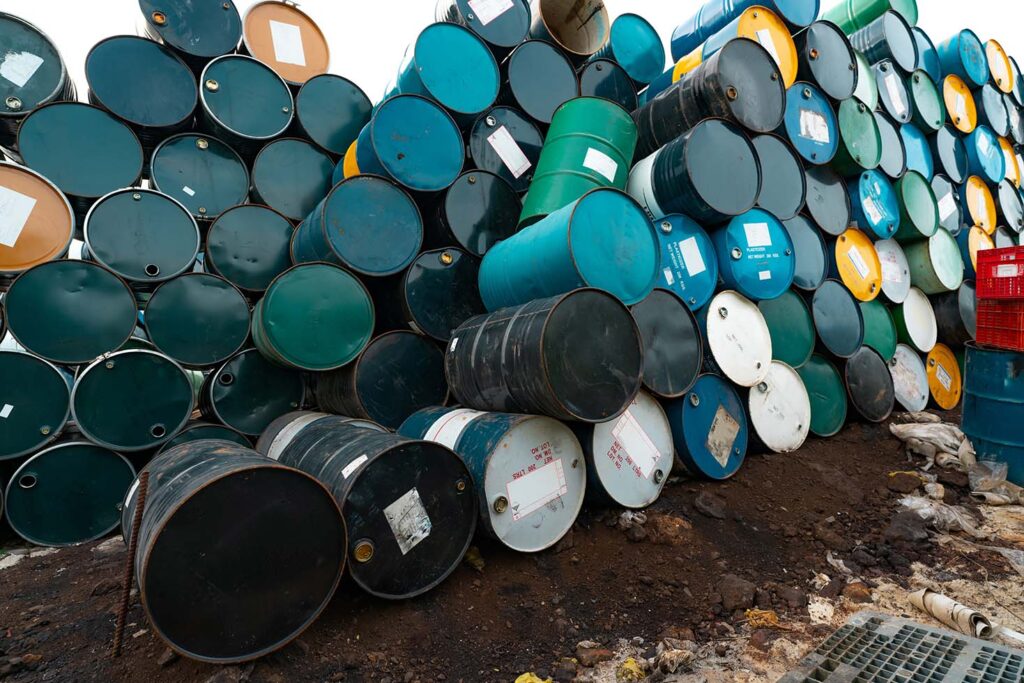
Hazardous Waste Management: What Generators Need to Know
Hazardous waste follows a facility from the moment it is generated to the moment it is destroyed or disposed, and federal law holds the generator responsible for every step in between. Managing it well comes down to a handful of questions. Is the waste hazardous? How much do you produce each month? How long can you store it? How do you ship it, and what do you have to report? This guide walks through hazardous waste management under the federal rules, the generator categories that drive most requirements, and the manifest and reporting changes that took effect in 2025. This comprehensive overview is brought to you by the environmental compliance team at Odyssey EHS.
What is Hazardous Waste?
Hazardous waste is solid waste that can harm human health or the environment if it is managed improperly, as defined under the Resource Conservation and Recovery Act (RCRA), the federal law the Environmental Protection Agency (EPA) administers. Waste is hazardous if it appears on one of EPA’s published lists or if it shows a hazardous characteristic. Most states run their own EPA-authorized RCRA programs, so the federal rules are the floor, not always the ceiling.
The term “solid waste” is broader than it sounds. It includes liquids, sludges, and containerized gases, not just dry material. That is why a spent solvent, a used acid, or an off-specification chemical product can all be hazardous waste even though none of them is solid in the everyday sense.
How Do You Know if Your Waste is Hazardous?
The generator, not the hauler or the disposal facility, is responsible for determining whether a waste is hazardous, and must do so at the point of generation. A waste qualifies in one of two ways: it is a listed waste that appears on one of EPA’s published lists, or it exhibits a hazardous characteristic. The four characteristics are ignitability, corrosivity, reactivity, and toxicity, and toxicity is measured by the Toxicity Characteristic Leaching Procedure (TCLP).
The duty to make this determination is set out in the Code of Federal Regulations (CFR), at 40 CFR 262.11, and it applies to every generator, including the smallest. A generator may base the determination on laboratory testing or on documented process knowledge, meaning a defensible understanding of what goes into the process and what comes out.
The listed wastes fall into four families:
- F-list wastes from common manufacturing and industrial processes, such as spent solvents
- K-list wastes from specific industries, such as petroleum refining or wood preserving
- P-list and U-list wastes, which are discarded commercial chemical products, with the P-list reserved for acutely hazardous chemicals
Getting the determination wrong is the root of most downstream problems. A waste that is misclassified as nonhazardous is stored, shipped, and disposed under the wrong rules from day one. Emerging contaminants add a layer of uncertainty here. EPA proposed listing nine PFAS as RCRA hazardous constituents, then withdrew that proposal on May 8, 2026, so PFAS compounds are not currently listed hazardous wastes under RCRA, even though several PFAS are now regulated as hazardous substances under CERCLA and through other programs.
Hazardous Waste Generator Categories
Federal rules sort generators into three categories by how much hazardous waste they produce in a calendar month, and the category drives nearly every other requirement. A Very Small Quantity Generator (VSQG) produces up to 100 kilograms a month. A Small Quantity Generator (SQG) produces more than 100 but less than 1,000 kilograms. A Large Quantity Generator (LQG) produces 1,000 kilograms or more. Producing more than one kilogram of acute hazardous waste in a month makes a facility an LQG regardless of its total volume.
Category is recalculated every month, so a facility can shift from one category to another as production changes. A planned or unplanned spike, called an episodic event, can push a generator into a higher category temporarily without permanently changing its status, provided it follows the conditions for episodic generation

*Under federal rules, VSQGs are not required to obtain an EPA ID#, but some states, including TX and LA, require VSQGs to obtain an ID/registration under their authorized programs.
How Long Can You Store Hazardous Waste On Site?
Accumulation time limits depend on the generator category. An LQG may hold hazardous waste on site for up to 90 days. An SQG may hold it for 180 days, or 270 days if the waste must travel more than 200 miles to a disposal facility. A VSQG has no federal time limit but is capped on how much it can accumulate at any one time. Running past the limit can convert a generator into a storage facility in the eyes of the regulator.
A generator that exceeds its accumulation time can be treated as operating a treatment, storage, and disposal facility, or TSDF, without a permit, which is a far more serious category of violation than a late shipment. Within the time limits, SQGs and LQGs also have to mark and date containers, keep them closed and in good condition, and inspect central accumulation areas weekly. Many facilities use satellite accumulation areas at the point of generation, where smaller volumes can be collected before the central accumulation clock formally starts.
Manifests and the Move to e-Manifest
Every shipment of hazardous waste leaving a site must travel with a Uniform Hazardous Waste Manifest, the cradle-to-grave tracking document that follows the waste from the generator to the receiving facility. Since January 22, 2025, all Small and Large Quantity Generators must register and maintain an account in EPA’s electronic manifest system, e-Manifest, and receiving facilities no longer mail back signed paper copies. Generators retrieve the final, signed manifest electronically instead.
A second phase took effect on December 1, 2025, moving exception, discrepancy, and unmanifested-waste reports, along with export manifests, into the electronic system. Very small quantity generators are not required to register. The practical effect is that someone at each regulated facility now needs an account in EPA’s system and has to monitor it, rather than waiting for paper to arrive in the mail.
Notification and Reporting
A generator that needs an EPA identification number obtains one by filing a Site Identification Form, EPA Form 8700-12. Reporting obligations then depend on the category. Small Quantity Generators must re‑notify their regulator at least every four years under federal rules, with specific deadlines set by individual states. Large Quantity Generators file the Biennial Hazardous Waste Report by March 1 of even-numbered years and re-notify on the same cycle.
The Biennial Report, EPA Form 8700-13, captures the quantities, types, and disposition of hazardous waste a Large Quantity Generator handled during the prior year. The most recent report was due March 1, 2026, covering 2025 activity, and the next is due March 1, 2028. This report is what most people mean when they search for hazardous waste reporting, and a missed deadline is an easy, avoidable violation.
How State Programs Change the Picture
Most states administer their own EPA-authorized RCRA programs, so the federal requirements are a national baseline that individual states can build on. Some states impose stricter standards, require annual rather than biennial reporting, add their own waste classification tiers, or regulate wastes that the federal rules leave alone. A program that satisfies the federal rules can still fall short of a particular state’s added requirements.
For an operator running facilities in more than one state, that variation is the real work. The federal framework gives you a common structure, but the determinations, forms, fees, and deadlines have to be checked against each state’s authorized program rather than assumed to carry over.
A Note for Oil and Gas Operators: The Bentsen Amendment
Operators in oil and gas get a specific carve-out. Under the Bentsen Amendment, exploration and production (E&P) wastes such as produced water, drilling fluids, and drill cuttings are excluded from RCRA Subtitle C hazardous waste regulation and are managed under separate state oil and gas rules. The exclusion is narrower than many operators assume. Wastes that are not unique to exploration and production, such as spent solvents, unused commercial chemicals, and laboratory wastes, remain fully subject to the hazardous waste rules.
The E&P exemption is a narrow hazardous‑waste carve‑out under RCRA Subtitle C, not a free‑pass from waste regulation; exempt E&P wastes remain subject to Subtitle D and state oil and gas rules. The E&P exclusion is waste‑specific and activity‑specific, not location‑based.
Misconception: “If it’s on a well pad, it’s exempt”
Another common misconception is that the E&P exclusion is location‑based: anything generated on a lease road, pad, or production facility is assumed to be “E&P exempt.” EPA and technical guidance instead define the exemption as waste‑specific and activity‑specific, applying only to wastes uniquely associated with the exploration, development, and production of crude oil and natural gas.
What Happens if You Get it Wrong?
Hazardous waste violations carry significant consequences. RCRA authorizes civil penalties assessed per violation and per day, and a generator that stores waste past its time limit can be treated as operating an unpermitted disposal facility, a more serious category of liability. Most enforcement, though, traces back to ordinary mistakes rather than bad intent.
The recurring failures are practical. A waste is misclassified at the point of generation. Containers sit past the accumulation limit. Manifests or the Biennial Report are late or incomplete. Staff who handle the waste were never trained on the current rules. None of these requires ill intent, and all of them are avoidable with a program that is set up correctly and maintained.
Additionally, generators remain responsible for hazardous waste management even after the waste leaves their facility, a concept referred to as “cradle-to-grave responsibility”.
Working with a Consultant on Hazardous Waste
Many operators handle routine hazardous waste tasks in-house and bring in outside expertise for the parts that carry the most risk: making defensible waste determinations, setting up compliant accumulation and labeling, registering and operating in e-Manifest, and keeping reporting on schedule across multiple sites. A specialized EHS partner that works nationwide can keep a multi-site program consistent while tracking how each state departs from the federal baseline.
Good support also builds the site team’s own capability, so the people closest to the waste can run the program day to day with expert backup when a determination is close or a new waste stream appears. The aim is a program the operator can stand behind in an inspection, supported by expertise when the questions get technical.
Frequently Asked Questions
What is the difference between a listed and a characteristic hazardous waste?
A listed waste is hazardous because it appears on one of EPA's published lists of specific wastes or processes, regardless of its measured properties. A characteristic waste is hazardous because it exhibits ignitability, corrosivity, reactivity, or toxicity, even if it is not named on any list. A single waste can be both listed and characteristic at the same time.
How is my generator category determined?
Your category is based on how many kilograms of hazardous waste you generate in a calendar month, not per year. Up to 100 kilograms makes you a Very Small Quantity Generator, more than 100 but under 1,000 makes you a Small Quantity Generator, and 1,000 or more makes you a Large Quantity Generator. Generating more than one kilogram of acute hazardous waste in a month makes you a Large Quantity Generator outright.
How long can I store hazardous waste on site?
A Large Quantity Generator may accumulate hazardous waste for up to 90 days, and a Small Quantity Generator for 180 days, or 270 days if the waste travels more than 200 miles to disposal. A Very Small Quantity Generator has no federal time limit but cannot exceed its accumulation quantity cap. Exceeding the time limit can subject the facility to full storage-facility permitting requirements.
Do very small quantity generators have to use e-Manifest?
No. Very small quantity generators are not required to register in e‑Manifest. For Small and Large Quantity Generators, EPA now requires registration and electronic access to final signed manifests; some generators work through corporate or third‑party accounts to manage this requirement.
What is the hazardous waste Biennial Report, and who files it?
The Biennial Report, EPA Form 8700-13, is a summary of the hazardous waste a Large Quantity Generator produced and where it went. It is due by March 1 of even-numbered years and covers the prior year's activity, so the report due March 1, 2026 covered 2025. Small and very small quantity generators are generally not required to file it.
Since E&P wastes are exempt, are they also unregulated?
Many operators assume the E&P (Bentsen) exclusion means drilling and production wastes are unregulated. In reality, most E&P wastes are only exempt from RCRA Subtitle C hazardous waste standards, but still regulated as solid wastes under Subtitle D and state programs.
If it comes from an E&P site, is it automatically exempt?
No. The E&P exclusion is waste‑specific and activity‑specific, not location‑based.
What are the most common hazardous waste compliance mistakes?
The frequent ones are misclassifying a waste at the point of generation, storing containers past the accumulation time limit, filing manifests or the Biennial Report late or incompletely, and letting staff training lapse. Most enforcement traces back to a gap between what the rules require and how the waste is actually managed on the floor.
Stay Compliant with Expert Hazardous Waste Management
Managing hazardous waste requires more than proper disposal; it demands accurate waste determinations, compliant storage practices, thorough documentation, and ongoing regulatory oversight. Odyssey EHS helps facilities develop practical hazardous waste programs that reduce risk and support long-term compliance.
Recent Posts
- Hazardous Waste Management: What Generators Need to Know
 An essential compliance guide breaking down 2026 hazardous waste regulations, explaining generator classifications, and detailing the critical manifest shifts site managers must follow.
 - Industrial Hygiene and Occupational Health Consulting
 Discover the critical shifts in industrial hygiene compliance, including the latest 2026 workplace exposure monitoring rules, MSHA silica standard changes, and keys to protecting your field crew.
 - Building an Effective EHS Audit Program: A Site Manager’s Guide
 A comprehensive, step-by-step framework for site managers to build a proactive EHS audit program, identify operational liabilities, and master facility waste compliance.
 - Establishment of a subsidiary company, Odyssey EHS Strategies, LLC.
 Wetlands Unlimited, LLC announces the establishment of a wholly-owned subsidiary company, Odyssey EHS Strategies, LLC. With WU’s growing presence in the environmental, health, and safety (EHS) market, it has become necessary to separate our wetlands and National Environmental Policy Act (NEPA) consulting services